Monday, 5 January 2015

Marlene Dumas, PORNO BLUES, 1993

Porno Blues, 1993, Ink wash, watercolour on paper,
6 drawings, 30.5x22.5 cm

In two series of drawings both made in 1993. Porno Blues and Porno as a Collage. Dumas used pages from sex magazines as her source material, investigating the interplay between photography's photographic revelations and the veilings and concealments of art, which are widely held to be distinguishing features of eroticism. Marlene Dumas has been laced in the tradition of Expressionism and compared to Edvard Munch and Emil Nolde.
Due to her ironic view of painting's production and perception she has also been considered a neo-conceptualist.
A further dimension in her work of the 1990s has been a distinctive exploration of eroticism. Although Dumas' imagery of predominantly female subject is often derived from mass-media photographic sources, she is not interested in strategies of refusal, or the constriction of 'anti-images' as a way of subverting stereotypical representations. Rather, through exploring the sensuous properties of her medium, she aims to expand the possibilities in painting for representation of the workings of desire.

Monday, 29 December 2014

Red Flag, 1971, Judy Chicago

Red Flag, 1971, Photo Lithograph, 51x61 cm (20x24 in), Judy Chicago

'"Offensiveness" played a potent part in destroying femininity and female beauty...for Judy Chicago, in her notorious Red Flag, a photo lithograph of herself from the waist down pulling out a bloody tampon.

Germaine Greer Suggested that to overcome disgust for one's menstrual blood, a woman should taste it. In order to overturn femininity, feminist artists necessarily flouted good taste and feminine respectability by pointedly showing women's desire for sexual and cultural power, manifested... by breaking the taboo ladylike purity. Red Flag takes a female bodily process out of obscurity; it is interesting to note that some viewers saw the tampon as an image of castration, which shows how much the eye has been socially and culturally educated to not see the reality of women's bodies.'

- Joanna Frueh, 'The Body Through Women's Eyes', 1994

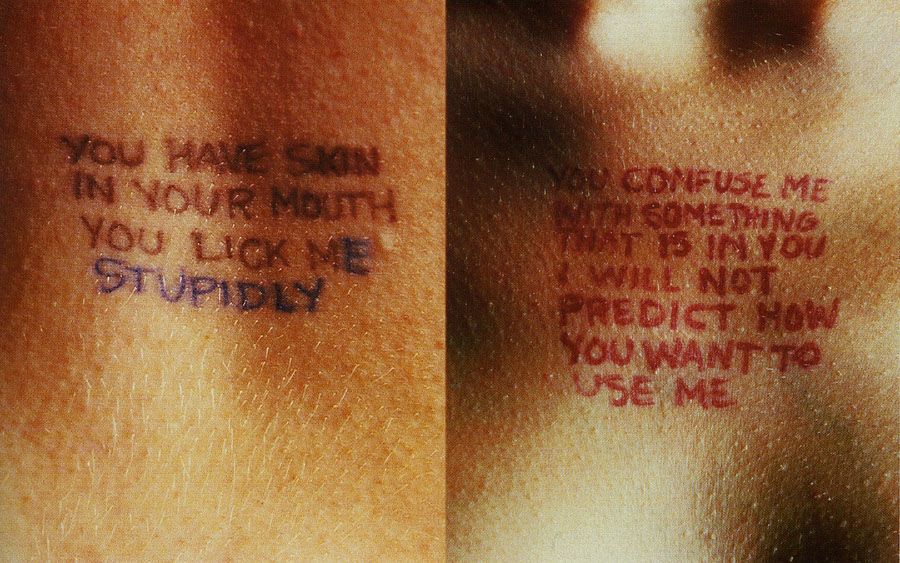
Jenny Holzer (with Tibor Kalman), LUSTMORD 1993-94

Photographs of handwriting in ink on skin 
32x22cm each


The English equivalent of the German word 'lustmord' is 'rape-slaying'. This was the title of several works Holzen made in the aftermath of war in the former Yugoslavia.

The project was first presented in Südeutsches Zeitung Magazin in Germany. Text were written on the skin of women volunteers, and presented as cropped photographs on the magazine pages. There is no way of knowing whether the skin surfaces belongs to a victim, perpetrator or observer. The texts similarly  alternate between the three view points. The magazine cover reproduced one of the texts in red ink mixed with blood provided by women involved in the project. The writing on the skin opens up the incongruity  between the rape as a traumatic act and its symbolic inscription. The inscriptions remain detached from the body: they are messages that can never convey the trauma of the act itself.


Thursday, 11 December 2014

Gustav Metzger: Auto-Destructive Art


Gustav Metzger painting with hydrochloric
acid on nylon. South Bank, London, 1961/1966.

Gustav Metzger: Auto-Destructive Art (1959)

Auto-destructive art is primarily a form of public art for industrial societies.
Self-destructive painting, sculpture and construction is a total unity of idea, site, form, colour, method, and timing of the disintegrative process.
Auto-destructive art can be created with natural forces, traditional art techniques and technological techniques.
The amplified sound of the auto-destructive process can be an element of the total conception.
The artist may collaborate with scientists, engineers.
Self-destructive art can be machine produced and factory assembled.
Auto-destructive paintings, sculptures and constructions have a life time varying from a few moments to twenty years. When the disintegrative process is complete the work is to be removed from the site and scrapped.  

Gustav Metzger: Manifesto Auto-Destructive Art (1960)

Man In Regent Street is auto-destructive.
Rockets, nuclear weapons, are auto-destructive.
Auto-destructive art.
The drop drop dropping of HH bombs.
Not interested in ruins, (the picturesque)
Auto-destructive art re-enacts the obsession with destruction, the pummeling to which individuals and masses are subjected.
Auto-destructive art demonstrates man's power to accelerate disintegrative processes of nature and to order them.
Auto-destructive art mirrors the compulsive perfectionism of arms manufacture - polishing to destruction point.
Auto-destructive art is the transformation of technology into public art. The immense productive capacity, the chaos of capitalism and of Soviet communism, the co-existence of surplus and starvation; the increasing stock-piling of nuclear weapons - more than enough to destroy technological societies; the disintegrative effect of machinery and of life in vast built-up areas on the person,...
Auto-destructive art is art which contains within itself an agent which automatically leads to its destruction within a period of time not to exceed twenty years. Other forms of auto-destructive art involve manual manipulation. There are forms of auto-destructive art where the artist has a tight control over the nature and timing of the disintegrative process, and there are other forms where the artist's control is slight.
Materials and techniques used in creating auto-destructive art include: Acid, Adhesives, Ballistics, Canvas, Clay, Combustion, Compression, Concrete, Corrosion, Cybernetics, Drop, Elasticity, Electricity, Electrolysis, Feed-Back, Glass, Heat, Human Energy, Ice, Jet, Light, Load, Mass-production, Metal, Motion Picture, Natural Forces, Nuclear Energy, Paint, Paper, Photography, Plaster, Plastics, Pressure, Radiation, Sand, Solar Energy, Sound, Steam, Stress, Terra-cotta, Vibration, Water, Welding, Wire, Wood.  

Gustav Metzger: Auto-Destructive Art Machine Art Auto-Creative Art (1961)

Each visible fact absolutely expresses its reality.
Certain machine produced forms are the most perfect forms of our period.
In the evenings some of the finest works of art produced now are dumped on the streets of Soho.
Auto creative art is art of change, growth movement.
Auto-destructive art and auto creative art aim at the integration of art with the advances of science and technology. The immediate objective is the creation, with the aid of computers, of works of art whose movements are programmed and include "self-regulation". The spectator, by means of electronic devices can have a direct bearing on the action of these works.
Auto-destructive art is an attack on capitalist values and the drive to nuclear annihilation

Wednesday, 10 December 2014

Gran Fury, Kissing Doesn’t Kill (1989), New York, Chicago, and DC


KISSING DOESN'T KILL: GREED AND INDIFFERENCE DO was a political art action manipulating advertising and media strategies to reach a broad audience with information about AIDS and the issues surrounding it. The project took place in two parts. The first was a large mailing of a postcard image of three kissing couples of mixed race and sex with the words "Kissing Doesn't Kill: Greed and Indifference Do." The back of the card read "Corporate Greed, Government Inaction and Public Indifference Make AIDS a Political Crisis." The image was designed to look much like a well known clothing industry ad campaign. The second part of the project was the production of the image and rejoinder as a 12 x 3 foot full color poster mounted on dozens of New York City buses. The poster was also prominently featured in the Whitney Museum exhibition "Media World". The poster has also been seen on buses in San Francisco and Chicago, as part of Art Against AIDS: On the Road.

Gran Fury is a collective of AIDS activists retaliating against government and social institutions that make those living with AIDS invisible. Through visual address, they seek to inform a broad public and provoke direct action to end the AIDS crisis. Gran Fury manipulates sophisticated advertising strategies to render complex issues understandable, and to reach an audience not often addressed by governmental and media information.

Guerilla Girls, Do Women Have to be Naked to get into the Met. Museum? (1990), New York

Asked to design a billboard for the Public Art Fund in New York, the political, feminist art-activist group Guerilla Girls set out to critique museums that display paintings of nude women to the exclusion of artby women. They conducted a “weenie count” at the Metropolitan Museum of Art, comparing the number of nude males to nude females in the artworks on display. Although its image was based on Ingres’ famous Grande Odalisque, the PAF rejected the work because it was too provocative. The MTA, however, agreed to run the billboards for a limited time.


The original image by Ingres without the addition of the gorilla head represents the kind of art that the Guerrilla Girls take issue with. The odalique, a harem woman, lies naked on a bed and looks seductively out from the canvas. Orientalist touches (fan, head wrap, fabrics and pipe) add a degree of exoticism to the image. In the feminist and post-colonial context an image like Ingres' is therefore highly problematic.

If you want to know more about Guerrilla Girls:

The Dinner Party (1974-79), Judy Chicago


Long-Term Installation
Elizabeth A. Sackler Center for Feminist Art, 4th Floor
The Dinner Party, an important icon of 1970s feminist art and a milestone in twentieth-century art, is presented as the centerpiece around which the Elizabeth A. Sackler Center for Feminist Art is organized. The Dinner Party comprises a massive ceremonial banquet, arranged on a triangular table with a total of thirty-nine place settings, each commemorating an important woman from history. The settings consist of embroidered runners, gold chalices and utensils, and china-painted porcelain plates with raised central motifs that are based on vulvar and butterfly forms and rendered in styles appropriate to the individual women being honored. The names of another 999 women are inscribed in gold on the white tile floor below the triangular table. This permanent installation is enhanced by rotating Herstory Gallery exhibitions relating to the 1,038 women honored at the table.